
Sample Quiz: College Algebra Chapter 3
Functions — College Algebra 2e (Jay Abramson)
10 questions · 23 points · answer key included
No account, no email — the file downloads straight away.
Multiple Choice
- Given f(x) = 2x2 + 1 and g(x) = 3x - 5, find f(g(2)). (2 PTS)
- 3
- 51
- 15
- 19
- Which of the following is the domain of f(x) = ()/(x-4)? (2 PTS)
- (-4, 4) ∪ (4, ∞)
- [4, ∞)
- [-4, ∞)
- [-4, 4) ∪ (4, ∞)
- A museum charges $5 per person for a group of 1 to 9 people or a fixed $50 fee for a group of 10 or more people. Based on the piecewise function shown in the textbook, what is the cost for a group of 15 people? (2 PTS)
- $100
- $150
- $50
- $75
- Which table represents a function? (2 PTS)
- Input: 1, 2, 1; Output: 5, 7, 9
- Input: 1, 5, 5; Output: 0, 2, 4
- Input: 2, 5, 8; Output: 1, 3, 6
- Input: 3, 3, 4; Output: 2, 5, 6
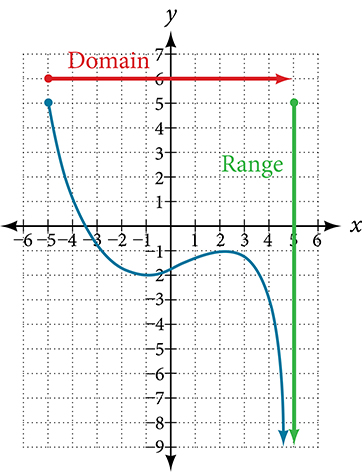
- Using the graph in Figure 9, what is the domain of the function f? (2 PTS)
- [-4, 0]
- (-4, 0)
- [-3, 1]
- (-3, 1]
True or False
- A piecewise function is a function in which more than one formula is used to define the output over different pieces of the domain. (1 PT)
- The domain of a function f(x) is the range of its inverse function f-1(x). (1 PT)
- The function f(x) = |x| is an example of a piecewise function because it uses different formulas for different parts of its domain. (1 PT)
Problem Solving
- A jeepney operator in Manila charges a fare based on distance traveled. The fare structure is: $0.50 per kilometer for distances up to 5 km, and a flat rate of $3.00 for distances greater than 5 km. Write a piecewise function F(d) that represents the fare in dollars as a function of distance d in kilometers. Then evaluate F(3) and F(7). (5 PTS)
- Given f(x) = 2x2 + 1 and g(x) = 3x - 5, find the composite function f(g(x)) and simplify your answer. (5 PTS)
Answer key
Multiple Choice
- 1.D — First evaluate g(2) = 3(2) - 5 = 1. Then f(g(2)) = f(1) = 2(1)2 + 1 = 3. Wait, let me recalculate: f(1) = 2(1)2 + 1 = 2 + 1 = 3. Actually the answer should be 3, which is option A. Let me verify once more: g(2) = 6 - 5 = 1, and f(1) = 2 + 1 = 3. The correct answer is A.
- 2.D — The radicand requires x + 4 ≥ 0, so x ≥ -4. The denominator requires x - 4 ≠ 0, so x ≠ 4. Combining these restrictions gives [-4, 4) ∪ (4, ∞).
- 3.C — According to the piecewise function, for n ≥ 10, the cost is C = 50. Since 15 people is in the group of 10 or more, the cost is $50.
- 4.C — A function requires each input value to correspond to exactly one output value. Option B has distinct inputs (2, 5, 8) each with a unique output, satisfying the definition of a function.
- 5.D — According to the worked example, the horizontal extent of the graph shown in Figure 9 is from –3 to 1, with an open circle at –3 and a closed circle at 1, giving a domain of (-3, 1].
True or False
- 1.True — This is the definition of a piecewise function as stated in the textbook, exemplified by the absolute value function and the museum pricing function.
- 2.True — According to the principle on domain and range of inverse functions, the domain of f(x) is the range of f-1(x).
- 3.True — The absolute value function is defined as f(x) = x when x ≥ 0 and f(x) = -x when x < 0, making it a piecewise function with two different formulas.
Problem Solving
- 1.The piecewise function is: F(d) = begincases 0.50d & if 0 < d ≤ 5 \ 3.00 & if d > 5 endcases. For F(3): since 3 ≤ 5, we use F(3) = 0.50(3) = 1.50 dollars. For F(7): since 7 > 5, we use F(7) = 3.00 dollars. — The piecewise function correctly captures the two different pricing structures based on the distance threshold of 5 km. The evaluations correctly apply the appropriate formula for each input value.
- 2.f(g(x)) = f(3x - 5) = 2(3x - 5)2 + 1 = 2(9x2 - 30x + 25) + 1 = 18x2 - 60x + 50 + 1 = 18x2 - 60x + 51. — To find f(g(x)), we substitute g(x) = 3x - 5 into f, then expand and simplify using the order of operations and algebraic rules.